

How k0rdent AI Automates Storage for Neoclouds: The VAST Data Integration
 Summarize with AI
 Claude
 ChatGPT
 Gemini
 Perplexity
 Grok
Deliver Sovereign GPU-Based Cloud Services
Build secure, compliant, and cost-efficient AI clouds using an open and composable AI infrastructure platform.
BUILD A SOVEREIGN AI CLOUD
A neocloud is a cloud built to deliver GPU capacity to customers. It might do that under an offtake agreement, in which a customer reserves a large block of GPU capacity in advance, usually for months or years, and the provider commits to deliver it by a fixed date. Or it might sell GPU-as-a-Service (GPUaaS), in which customers rent smaller amounts of capacity on demand and pay for what they use. Either way, it has a storage requirement that is hard to meet at scale. Every customer environment needs shared, high-throughput storage for its datasets and checkpoints. That storage has to be ready the moment the environment is handed over, and it has to be isolated from every other customer. It also has to be accounted for in a way you can bill and audit.
Meeting that requirement by hand works at the beginning, when you have only a few customers. An operator logs into the storage array, creates a share, and passes the mount details along. It doesn't work well for offtake deployments, where a large amount of capacity has to come online at once, to a specification the customer has agreed to, and by a date written into a contract. Every cluster in that delivery needs its own storage attached and verified before it can be handed over. If each cluster depends on an operator doing that work by hand, the delivery takes as long as the operator does, and any mistake is discovered at handover.
Manual provisioning doesn't work for a GPUaaS business either: customers arrive and leave continuously, and there's no schedule to plan the work around. Over time, as a neocloud business becomes more diversified and dynamic – smaller clusters, more complex workloads – the need for automation quickly becomes a driving economic imperative. Storage provisioning has to be as automated as the compute provisioning it goes with, and governed by the same policies.
We built k0rdent AI to meet this requirement. Its storage integration framework provisions isolated, quota-bound storage on external storage arrays as part of delivering a cluster, with no human in the loop. VAST Data is the first storage platform we support in production, and this post describes what that integration does today.
Architecture
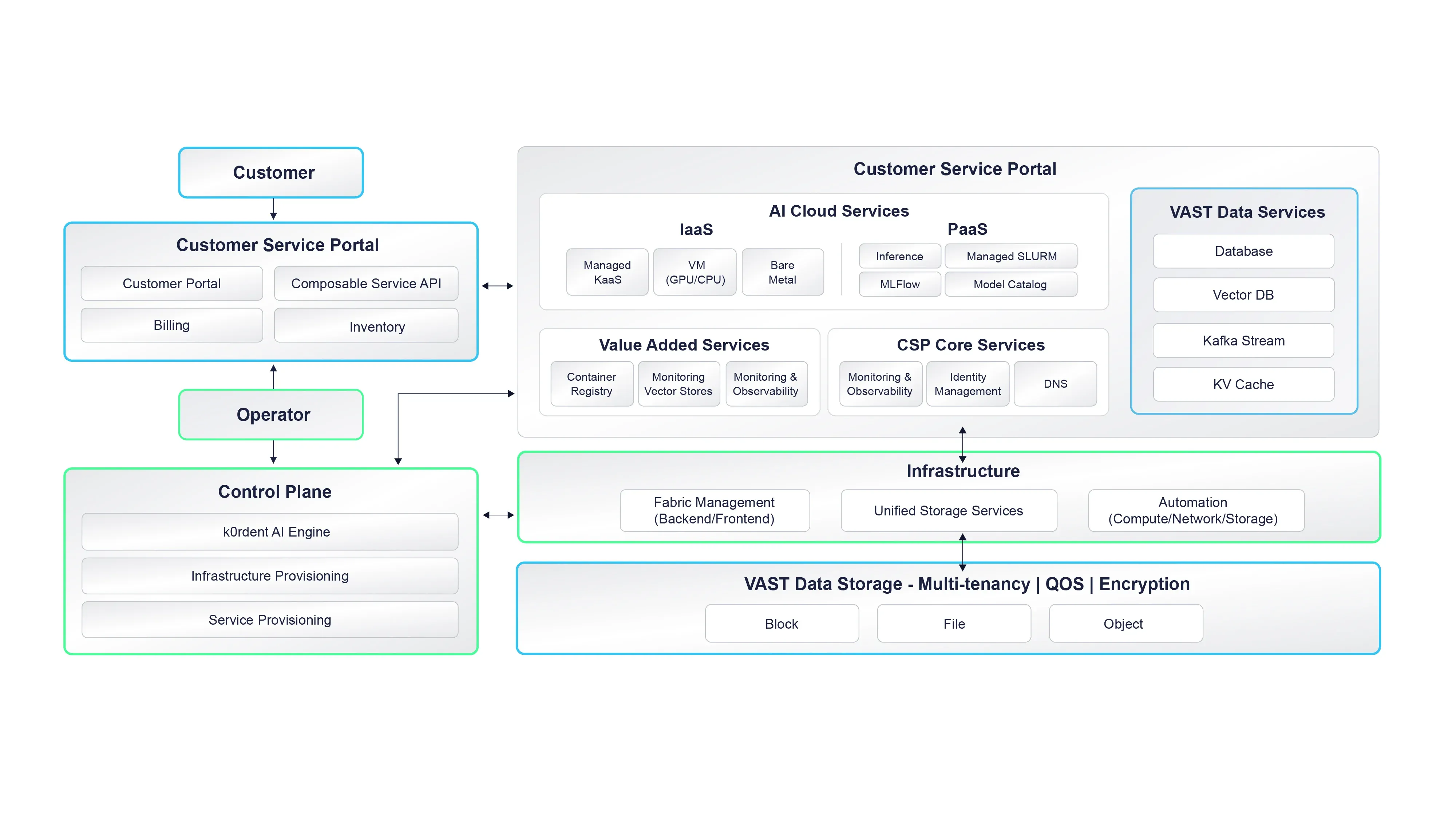
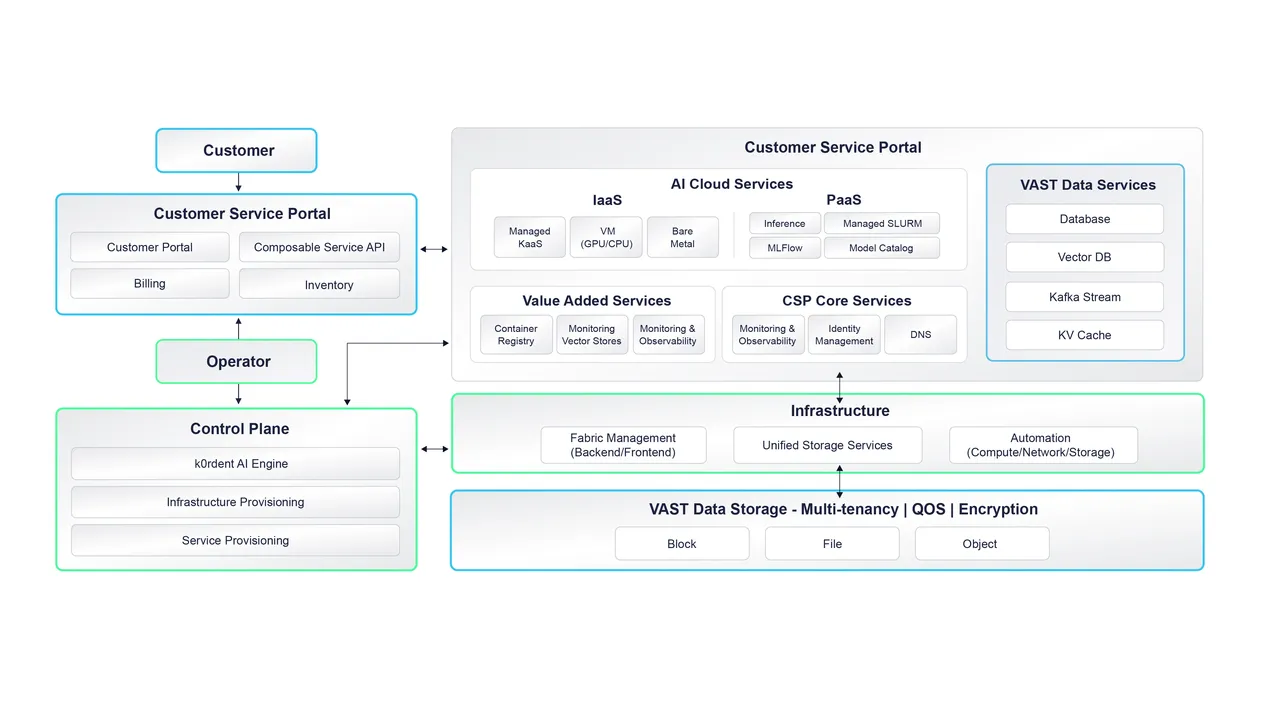
Our framework rests on a single principle: the k0rdent AI API is the sole interface to everything, and storage is no exception. The k0rdent AI backend, in turn, is the only component that talks to a storage vendor's own API. An organization declares how much capacity it needs and receives working storage. Which array sits behind that storage is the operator's concern; it never shows up in the organization's workflow.
To make that possible, we built an abstraction layer that sits between k0rdent AI and each storage provider's own interfaces. Every storage vendor exposes its features in its own way: through a management API, through a CSI driver (the Container Storage Interface, which is the standard mechanism Kubernetes uses to attach storage to workloads), or both. Rather than teach k0rdent AI each of those dialects, our layer translates between them and the objects k0rdent AI already understands.
On the k0rdent AI side, those objects are organizations, the projects inside them, and the bare metal instances and Kubernetes clusters that projects run. On the VAST side, they are tenants, views, and quotas. When a project asks for a cluster with storage, the layer makes the translation. The cluster gets a VAST tenant, the storage request becomes a VAST view with a quota attached, and the credentials that come back are scoped to that cluster alone.
VAST is the first full implementation of this layer. The framework was designed so that future storage integrations can plug in without any API changes or impact to the tenant experience, and our v1 API semantics intentionally cover only the capabilities that storage arrays have in common. Provider-specific functionality sits outside this layer by design.
That limit applies to the control plane, not the data path. Our layer standardizes how storage is requested, isolated, metered, and reclaimed, and leaves what the array does with the data to the array. A workload on VAST still gets VAST's throughput, data reduction, and resilience, because those come from the array and the client rather than from our API.
k0rdent AI already exposes the VAST capabilities customers use most: the common cross‑array features found across high‑performance storage platforms. Advanced capabilities that are unique to VAST remain available through the VAST console, giving operators full access when needed while keeping the k0rdent AI experience streamlined and consistent across arrays.
What the VAST Integration Does Today
Provisioning. A customer asks for a Kubernetes cluster and says how much storage it should have, and that is all they need to specify. k0rdent AI then carves out a private space for that cluster on the VAST array, sets the size limit, creates credentials that work for that cluster and nothing else, and installs the software the cluster needs to use the storage. By the time the customer logs in, their workloads can already save data to it. Bare metal servers get the same thing in a slightly different form: a network file share, delivered along with the instructions for connecting to it. On bare metal, the customer runs that last step themselves, because the operating system belongs to them rather than to the platform.
Isolation. Each Kubernetes cluster gets its own VAST tenant (VAST's own unit of separation) and its own credentials. Bare metal file stores share one tenant per project, with access limited to each store's client addresses. The size limit is enforced by VAST itself, so no customer can exceed it. When a cluster is deleted, its storage is deleted with it, and we check the array to confirm the space is free before anyone else can have it. As a safeguard, if storage still has data volumes attached, deletion is refused unless an operator explicitly forces it.
Data path. Clusters and servers access the storage over NFS (Network File System), a protocol every Linux system already understands, using the exact version specified in NVIDIA's storage requirements, the same configuration we've fully validated. VAST also offers a faster client of its own, which spreads traffic across several network paths and uses RDMA (Remote Direct Memory Access) to move data without going through the CPU. Our design supports that client as well, and validating it is next on our list.
Lifecycle operations. Over the life of a cluster, a customer can add storage to it, raise a size limit, see how much of their allowance they've used, and delete what they no longer need, all without filing a ticket. Operators can add a storage array to the platform, see how much they've promised against how much the array actually holds, and act on a customer's behalf when needed, with a record of who did what.
Multi-tenant networking. On a shared array, keeping customers apart depends on how the array identifies each one. On the VAST release in production today, the one NVIDIA has validated, the array identifies each customer by the network addresses its clusters connect from, and k0rdent AI keeps those address lists current as clusters come and go. Nobody touches the network configuration by hand, and the approach scales to thousands of customers on one array. The next VAST release adds a second option: mutual TLS (mTLS), where the cluster and the array authenticate each other using certificates. Our framework supports both methods.
What This Means for Offtake Deployments
In an offtake deal, a customer commits to a defined quantity of GPU capacity under strict delivery deadlines. If storage isn't attached and ready the minute the compute comes online, the cluster sits idle, and the delivery timeline fails.
To eliminate that bottleneck, the storage integration enforces three foundational guarantees:
Zero-touch automated provisioning: Storage attaches automatically with zero manual operator steps. Our operational target for human intervention is strictly zero, because when capacity relies on manual provisioning, GPUs come online on the operator’s schedule, not the hardware’s.
Hard boundaries on overcommit: The system gives operators real-time visibility into physical capacity, committed quotas, and sellable headroom. Instead of silently relying on thin provisioning, which risks sudden outages down the line, the platform forces operators to set overcommit ratios explicitly and rejects excess allocations with clear, distinct errors.
Proven multi-tenant isolation: Each cluster receives a dedicated VAST tenant with scoped credentials that can access only that specific allocation. Error responses are sanitized to reveal nothing about the underlying array, endpoints, or neighboring tenants, while every API call is tied directly to the caller, cluster, and tenant in the audit log.
What This Means for GPU-as-a-Service
While offtake deployments serve a few massive, long-term tenants, GPU-as-a-Service (GPUaaS) caters to hundreds of smaller developers spinning workloads up and down on independent lifecycles. The underlying framework handles both models using the same core architecture:
Frictionless self-service billing: Billing aligns strictly to declared quotas, and developers expand storage on-demand via standard API calls without opening support tickets.
Zero network reconfiguration at scale: By utilizing a shared virtual IP (VIP) pool, onboarding a new tenant requires no manual network tweaks on the storage array.
Decoupled resilience (data path vs. control plane): If connectivity to the storage management layer drops, running workloads are never affected. Existing tenants continue reading and writing data without interruption; only administrative changes (like creating new quotas) are temporarily paused.
Unified infrastructure: The same storage API powers both containerized Kubernetes environments and bare metal servers, allowing providers to support multiple compute offerings with a single storage backend.
Best of all, this architecture isn't locked to one hardware ecosystem. The integration layer was built by Mirantis to be completely vendor-neutral, with VAST serving as our first production-tested backend.
What's Next
Our storage integration will continue to evolve across both the data path and the control plane. We are enhancing how the platform connects to and communicates with the array, including support for mutually authenticated transport. Beyond that, we remain committed to expanding the integration over time, introducing additional capabilities in future releases and broadening the list of supported storage array vendors. VAST‑specific functionality will continue to be fully accessible through the VAST console, while k0rdent AI will steadily increase the set of features it exposes directly.
Learn More
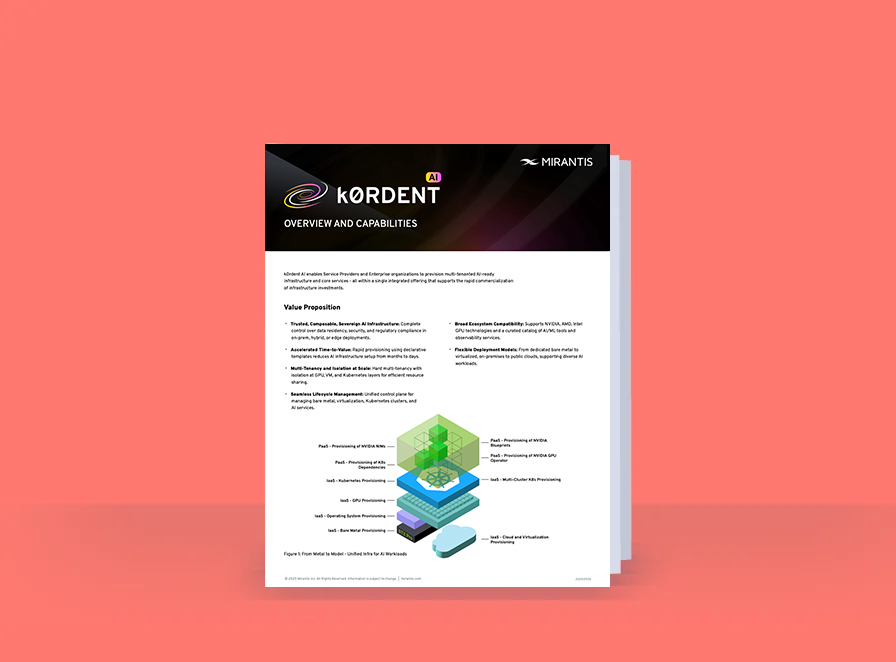
Please review the solution brief for this integration, then contact us to talk through the storage requirements of your own environment.